I’ve spent a career telling people that “Fiber is King.” And generally, that’s true. If you can get a diverse, high-capacity fiber strand into your building, that is the gold standard.
But here is the messy reality of the “In-the-Trenches” life: Fiber is slow.
Not the data transmission—that’s the speed of light. I mean the construction. If you open a new branch office, a retail store, or a remote logistics hub, waiting for a carrier to secure permits, dig trenches, and pull glass can take 90 days. Sometimes six months.
Your business does not operate on “construction time.” Your business operates on “now.”
For a long time, wireless was the red-headed stepchild of enterprise networking. It was the “break glass in case of emergency” backup. It was expensive, it was capped, and it was unreliable.
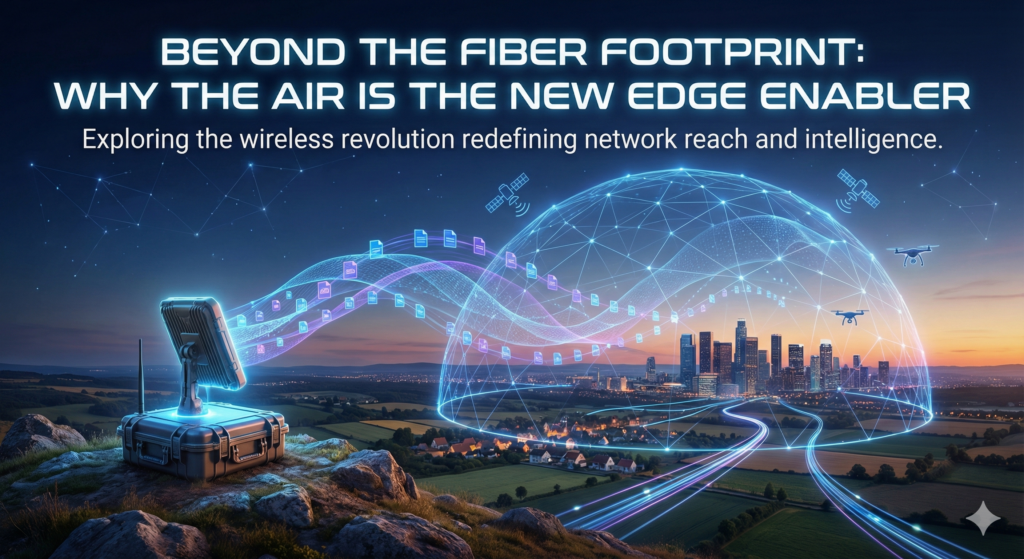
That era is over for the branch. The “Last Mile” is no longer just about the ground beneath our feet. It’s about the sky above us.
The “Day One” Problem
Let’s look at a common scenario. You acquire a company, or you need to spin up a pop-up location for a seasonal rush. You call your telco provider, and they tell you, “Great, we’ll have circuits installed by Q3.”
Q3? You need to be transacting revenue next Tuesday.
This is where 5G and LTE have shifted from “backup” to “business enabler.” We are seeing sophisticated enterprises use wireless as their primary connectivity for the first six months of a site’s life. They ship an SD-WAN box with a 5G SIM card to the site, plug it in, and they are online. When the fiber finally shows up months later, the 5G simply shifts roles to become the backup.
This is “Day One Connectivity,” and it changes the relationship between IT and the business. You stop being the bottleneck.
The LEO Revolution: Starlink and Kuiper
The most exciting shift, however, isn’t on the cell tower. It’s in Low Earth Orbit (LEO).
For decades, “satellite internet” was a dirty word in our industry. It meant high latency (700ms+), expensive data caps, and service that dropped whenever it rained. That’s because those old satellites were parked in Geostationary Orbit, 22,000 miles away. That’s a long commute for a data packet. Not to mention the good ones were 7 feet in diameter and required a metric ton of concrete to hold them in place.
Enter the new players: Starlink (SpaceX) and Project Kuiper (Amazon).
These constellations orbit vastly closer to Earth (around 350 miles up). The physics changes entirely.
- Latency drops: We are seeing ping times that rival terrestrial cable connections (20ms – 40ms). In my own testing I’ve out-performed my own DSL connection on a priority type service.
- Capacity increases: You can actually run a business on this. Teams calls, ERP data, cloud syncing—it just works. I only discover people are full time on Starlink now when they mention it, rather than knowing up front when I see poor quality video on a Zoom call like a poor quality cable connection would have at times.
We are entering a world where “remote” doesn’t mean “disconnected.” I’ve seen mining sites, rural manufacturing plants, and even executive home offices switch to LEO connectivity because the local DSL provider hasn’t upgraded their copper since the 90s. With Amazon’s Project Kuiper entering the fray, we are about to see a massive competitive race that will only drive costs down and performance up for the enterprise.
Diversity That Actually Means Something
There is another massive advantage to the wireless/satellite edge: True Diversity.
I can’t tell you how many times I’ve seen a client pay for “diverse” fiber paths, only to find out that both carriers run through the exact same conduit under the exact same bridge. When the backhoe hits one, it hits both. Game over. If they pay extra, sometimes the conduit is separated but still on that same bridge!
From my perspective, if you have fiber primary, broadband secondary and LEO tertiary connectivity. You better have a generator as well, because if all three of those go down at the same time your connectivity is probably the least of your concerns at that point.
Wireless and Satellite offer true physical separation. A backhoe cannot cut a radio wave.
By mixing media—Fiber for the primary, 5G or LEO Satellite for the secondary—you are creating a network architecture that is resilient against the most common physical failures.
Taming the Wild West
Now for the pragmatic warning: Do not just go buy 1,000 Starlink dishes on a corporate credit card.
Wireless scaling is messy. Managing data plans, SIM cards, signal strength, and proprietary satellite hardware across 500 locations is an operational nightmare.
This brings us back to the SD-WAN brain. The magic happens when you plug these “wild” connections into your intelligent Edge platform. The SD-WAN doesn’t care if the link is Fiber, 5G, or Satellite. It just sees (& measures) bandwidth. It manages the failover, it handles the encryption, and it gives you a single dashboard to see it all.
The Hybrid Future Includes Vertical
The future of the enterprise edge isn’t just about more fiber. It’s about a hybrid mix of glass, cellular, and space-based connectivity.
We finally have the tools to reach any user, anywhere, with business-grade performance. The excuse of “we can’t get good service there” is rapidly disappearing. If you can see the sky, you can be part of the enterprise.