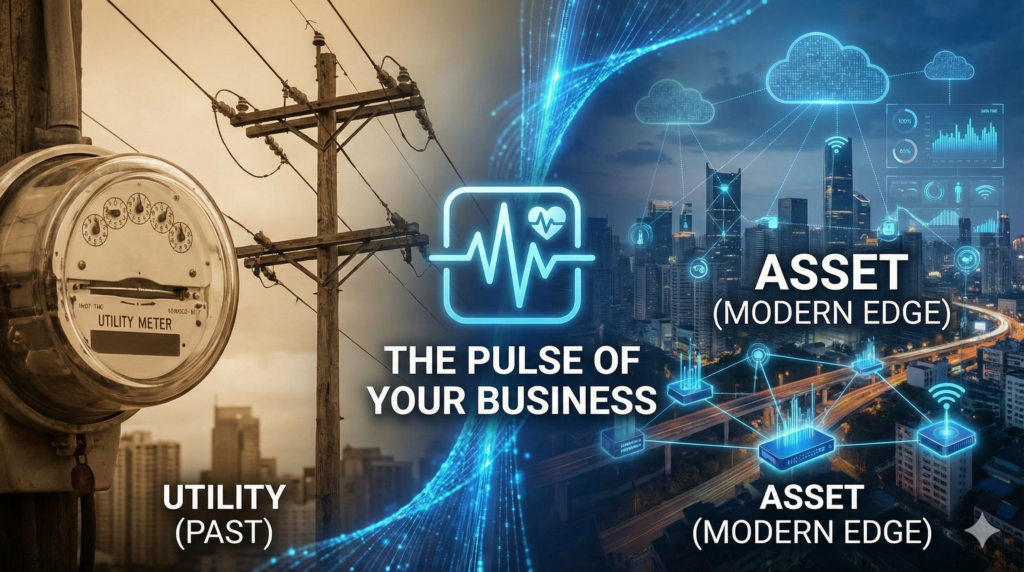
For decades, the enterprise network has been treated like a utility. It was a sunk cost, a line item on the P&L similar to electricity or HVAC. The primary questions from the C-suite were simple: “Is it on?” shortly followed by “Can we pay less for it?”
This “utility mindset” ignores a fundamental reality of the digital age: The network is the only system in your organization that touches every single application, user, and data point.
When you treat the network as a dumb pipe, you are paying for plumbing. But when you upgrade to the modern Edge—leveraging SD-WAN and SASE—you stop paying for plumbing and start investing in a nervous system. You gain a source of business intelligence that can fundamentally change how your IT team operates.
The Intelligence Revolution
In the legacy MPLS world, the network’s job was to move packets from A to B. It didn’t care what the packets were. A mission-critical ERP transaction looked exactly the same as a cat video on YouTube. The only difference in a well designed MPLS network would be a properly formatted DSCP marking on that ERP transaction to know it was more important.
The modern Edge changes the value proposition because it is application-aware.
Suddenly, you aren’t just pushing traffic; you are analyzing it. A modern SD-WAN solution doesn’t just tell you that your bandwidth utilization is high; it tells you why.
- Is productivity stalling because a software update is flooding the pipe during business hours?
- Are your expensive dedicated circuits being clogged by recreational web browsing?
- Is a critical cloud application timing out due to latency on a specific ISP link?
This shift turns technical noise into actionable business data. You can stop buying expensive bandwidth for non-critical traffic and start reserving your premium lanes for the voice and data that actually drive revenue.
Security as Visibility
This visibility extends naturally into security. As we move toward SASE (Secure Access Service Edge), we are integrating security functions directly into the network fabric.
In a decentralized workforce, “Shadow IT” is a massive blind spot. Employees sign up for unauthorized SaaS tools to get their jobs done, bypassing corporate standards. A traditional firewall at the data center might miss this entirely if the user is working from home.
However, an intelligent Edge sees the traffic flow regardless of location. It provides a map of how your employees are actually working. It allows you to identify unauthorized applications not just to block them, but to understand why employees are using them. Often, Shadow IT is a signal that the corporate-approved tools aren’t meeting business needs. The network reveals that gap.
The Efficiency Paradox
The most compelling argument for this transformation is what I call the “Efficiency Paradox”: You can often spend less overall while gaining more capability. Often the sweet spot is paying the same, but gaining a ton more business value in the process.
By moving away from rigid, hardware-heavy private networks toward software-defined architectures, you reduce the reliance on expensive proprietary hardware. But the real ROI comes from the intelligence.
- Faster troubleshooting: Mean Time to Innocence (MTTI) drops when you can instantly see if the problem is the network, the app, or the server.
- Better vendor management: You have the data to hold your ISPs and SaaS providers accountable to their SLAs.
- Smarter planning: You stop over-provisioning bandwidth “just in case” and start provisioning based on actual usage patterns.
Stop Paying for Plumbing
If your network report only tells you about uptime and latency, you are getting shortchanged.
Your network sees everything your business does. It knows which applications are powering your growth and which are draining your resources. It’s time to stop treating it like a utility bill and start using it as the strategic asset it really is.
(This post is inspired as an expansion on discussion during a webinar I presented in on the Enterprise and evolution of the Edge).