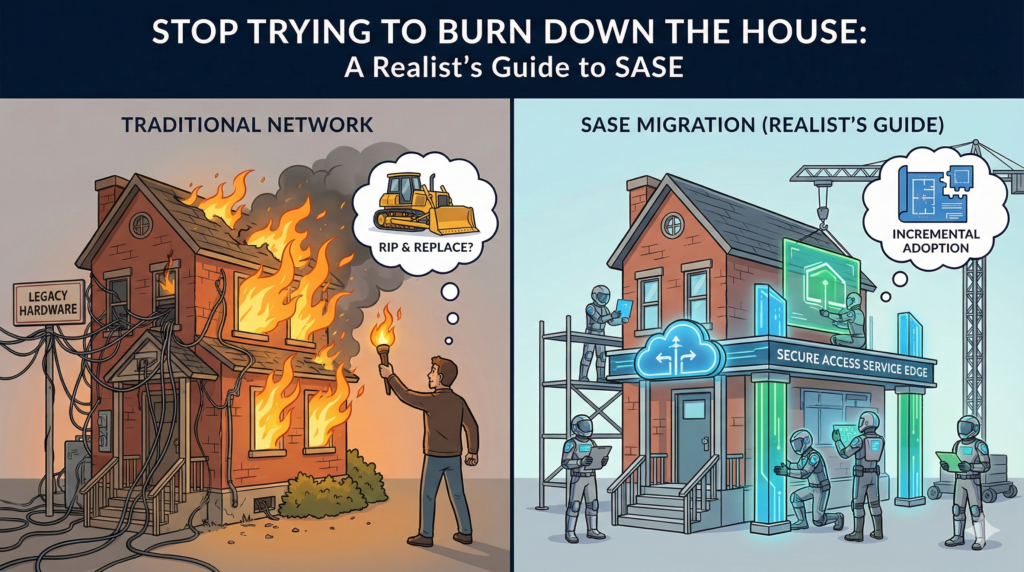
Let’s be honest: nobody starts with a blank sheet of paper.
I was recently discussing the state of edge connectivity, and it struck me how often the industry ignores the reality on the ground. If you’re reading this, your network diagram probably looks less like a clean blueprint and more like a plate of spaghetti. You’ve got legacy MPLS circuits you’re afraid to touch, a firewall from a decade ago sitting in a closet in Chicago, and a leadership team asking why we can’t just “move everything to the cloud” by Friday.
We need to stop pretending our networks are these pristine, cloud-native environments. They’re messy. They have “basements” full of junk we’ve accumulated over twenty years.
And that’s exactly why the “rip and replace” mentality is dangerous.
The “Wrap It,” Don’t “Rip It” Approach I talk a lot about “wrapping” legacy tech rather than ripping it out. Think of it like renovating a historic house. You don’t bulldoze the foundation just because you want Wi-Fi and better insulation. You work around the load-bearing walls.
In our world, this means acknowledging that you can’t just throw out your old hardware overnight. You need a strategy that lets you keep the lights on while you transition to the Edge. You wrap that legacy infrastructure in a modern software layer—like SD-WAN or SASE—that gives you visibility and control without requiring a forklift upgrade on Day One.
Go Slow to Go Fast There’s a phrase I live by in my day job: “Go slow to go fast.” It sounds like a paradox, but in IT, it’s survival.
If you rush to deploy SASE just because you saw a cool demo, you’re going to hit a wall. You have to understand your traffic patterns first. Where are your users? Are they actually at the HQ, or are they sitting in a coffee shop in Denver accessing an app hosted in AWS East?
If you don’t do the detective work upfront—if you don’t map the plumbing before you turn on the water—you’re just building a faster way to crash your network.
The Bottom Line Don’t let vendors shame you about your “technical debt.” We all have it. The goal isn’t to have a perfect network; it’s to have a network that is slowly, steadily getting smarter, moving the intelligence from the data centre out to the edge where your actual work happens.
(This post is part of a series expanding on a panel discussion I was a participant on at the C3 tech summit in 2025.)