Dealing with Generation Z in the B2B world often feels like playing a modern video game on “Hardcore” mode. You don’t get a tutorial, mistakes are punished instantly, and if your interface lags—even for a millisecond—they simply quit the server.
We used to use the term “Digital Native” to describe this cohort, but that term has lost its edge. It applies to Millennials too. Gen Z is different. They aren’t just native speakers of the digital language; they are the architects of a new kind of digital skepticism.
I recently watching a Gen Z developer evaluating options for a new SaaS platform for a project I was advising on. The speed at which they dismissed options was terrifying to a traditional sales professional. They didn’t read the white papers. They didn’t watch the CEO’s vision video. They went straight to the documentation, then to the Reddit threads, then to the pricing page.
If they encountered a “Book a Demo” button where a price tag should be, the tab was closed. Immediate disqualification.
It wasn’t impatience. It was a high-sensitivity filter for anything that felt performative. We are building systems for a generation that grew up in an era where “content” is often synthetic and “truth” is often subjective. They don’t trust the suit in the boardroom, and they certainly don’t trust an AI that sounds like a suit.
The “Rep-Free” Reality: Why Discovery Calls Are Dead
Here is the hard truth for my fellow sales leaders and product managers: “High Touch” sales models are dying.
For thirty years, the B2B playbook has been the same. You gate your pricing. You gate your documentation. You force the prospect to fill out a “Contact Us” form, and then you deploy a Sales Rep to “qualify the lead.”
To this new generation of buyers, a mandatory phone call to get pricing isn’t a service; it’s friction. It is a broken link in the chain. It’s like forcing someone to mail a physical check to pay for a streaming service.
I see this constantly in the telecom and managed services sector. When we force a user to “Contact Sales” to unlock a feature, the drop-off rate for users under 30 spikes vertically. They don’t want a relationship manager. They want a toggle switch. They treat vendors like utilities: I flip the switch, the light comes on. I don’t need to have coffee with the electrician every time I want to use the microwave.
This isn’t about introversion. It’s about efficacy. This generation has grown up with APIs that work instantly. If they can set up a complex game server or a cloud instance in three clicks, why does it take three weeks and four meetings to set up a cloud firewall?
The “Imposter” Logic: Security as Intuition
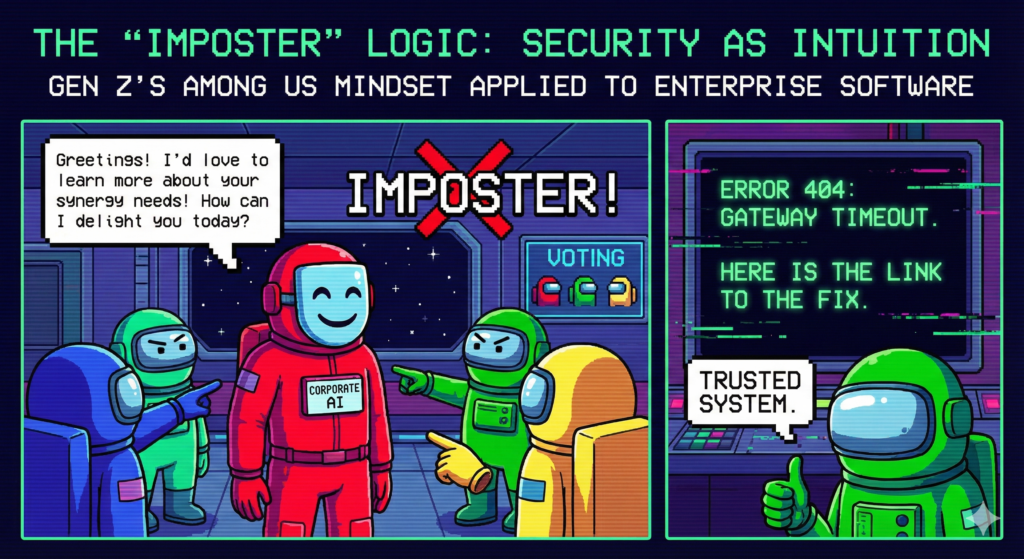
There is a cultural touchstone that defines this mindset better than any Gartner report: the game Among Us.
For those who missed it, millions of young people spent the pandemic years playing a simulation where the entire objective was to identify the imposter on the ship. They trained their brains to look for inconsistencies in behavior. They learned that the person talking the loudest about “safety” was often the threat.
Gen Z applies this same “Imposter Logic” to enterprise software.
If your AI chatbot pops up and says, “Greetings! I’d love to learn more about your synergy needs! How can I delight you today?” it gets voted off the ship. It sounds fake. It sounds like a script.
But if the system says, “Error 404: Gateway Timeout. Here is the link to the fix,” they trust it.
They respect competence, not charisma. In my line of work—edge networking, SASE, and cybersecurity—this is a massive paradigm shift. We used to sell “Peace of Mind” (an emotional promise). Now we need to sell “Root Access” (a technical reality). Co-management is a given today where it was unthought of 10 years ago.
If you hide your API documentation behind a login wall, they assume your API is broken. If you hide your pricing, they assume you are expensive and dishonest. Transparency isn’t a marketing buzzword for them; it is the functional baseline requirement for interaction.
The Castle vs. The Marketplace
I’ve spent years building “secure castles”—firewalls, perimeters, moats. The traditional cybersecurity model is based on the idea of a defined perimeter. Inside the office is safe; outside is dangerous.
But Gen Z doesn’t live in the castle. They live in the marketplace outside the walls—the Cloud, the Edge, the SASE (Secure Access Service Edge) framework. Many have never even been inside a physical office in their working career as a daily routine.
For them, security isn’t about locking doors; it’s about identity portability. They demand Multi-Factor Authentication (MFA) not because the IT policy says so, but because they value their digital assets—their Steam accounts, their crypto wallets, their cloud configs—more than physical assets. They are security-conscious, but privacy-paranoid.
This creates a conflict in corporate IT. We try to lock down their devices with MDM (Mobile Device Management) profiles that feel restrictive and clumsy. They bypass them. Not out of malice, but out of a need for speed. If our corporate VPN adds 50ms of latency to their workflow, they will find a way around it.
The challenge for us isn’t to build higher walls. It’s to build faster gates. We need security that moves at the speed of their thought process. If security slows them down, they view it as a bug, not a feature.
The Aesthetic of Truth
There is even an aesthetic component to this. Look at the design trends that appeal to this generation. They reject the sanitized, cheerful “Corporate Art” style that dominated the last decade. They prefer raw functionality. They like “Dark Mode” by default. They prefer a terminal window to a drag-and-drop interface if the terminal is faster.(I have to agree with them on this part!)
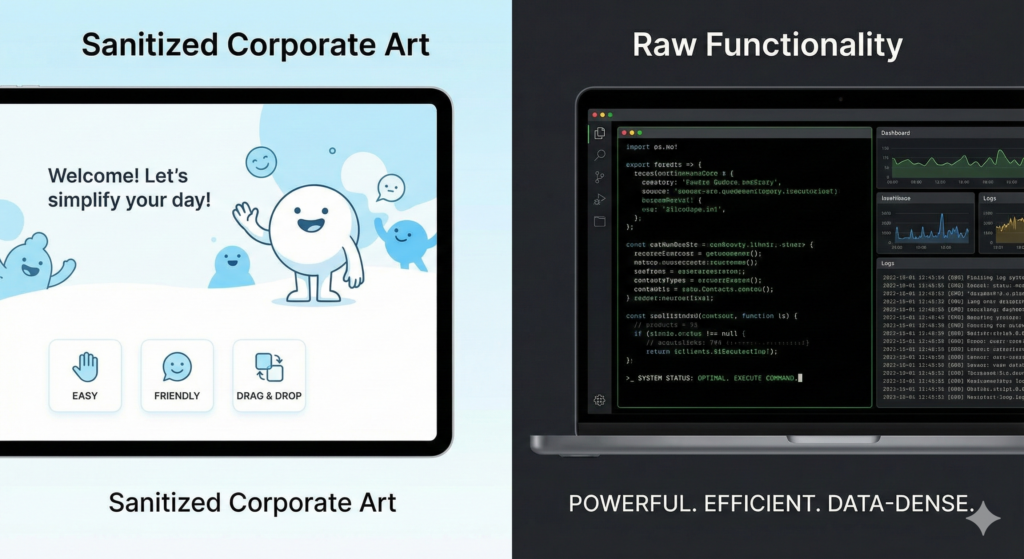
When we design interfaces for them, we need to stop trying to make enterprise software look friendly. Make it look powerful. Give them the data density. Don’t simplify the dashboard so much that it becomes useless. They can handle the complexity; what they can’t handle is the condescension of a dumbed-down UI.
Remember, this generation grew up on the Twitter firehose style of information feeds. We may criticize their 15sec attention span on TikTok, but it really shows their ability to rapidly consume and assess information at lightening speeds.
The Takeaway: Stop Selling, Start Solving
So, how do we survive the rise of this new filter?
If you want to win this generation, stop trying to “nurture” them into a marketing funnel.
- Give them the Keys: Let them play with the product before they buy it. Freemium isn’t a pricing strategy; it’s a verification strategy.
- Open the Books: Make your documentation public. If the answer isn’t indexable by a search engine, your product effectively doesn’t exist.
- Enable the Builders: They don’t want a “Solution Architect” to design it for them. They want the Lego bricks to build it themselves.
If I can’t explain my product’s value in the time it takes to scan a status update, I haven’t simplified it enough. And neither have you.
The future of B2B isn’t about better sales scripts. It’s about better systems. The “Authenticity Filter” is flashing red. It’s time we started listening to it.