TL;DR: The days of measuring success by “circuit up-time” and “bandwidth” are dead. Welcome to the era of Intelligent Resilience, where the winners aren’t the ones with the fastest links, but the ones who can keep the lights on when the power bill doubles and the AI starts hallucinating.
One of the most famous examples of immense preparation undone by a tiny, simple oversight is the story of the RMS Titanic and the missing binocular locker key.
While the ship is famous for its lack of lifeboats, that was a regulatory failure. The specific failure that led to the collision itself serves as a stark warning: a massive, state-of-the-art machine brought down because one man forgot to hand over a physical key.
The Precautions: “The Unsinkable Ship”
The Titanic was the pinnacle of naval engineering in 1912. The White Star Line and the shipbuilders (Harland and Wolff) had taken extraordinary precautions to ensure the ship was safe:
Watertight Compartments: The hull was divided into 16 watertight compartments. The ship could stay afloat with up to four of these flooded.
Double Bottom: A second layer of steel protected the bottom of the ship from running aground.
Experienced Crew: The ship was captained by Edward Smith, the most experienced and respected commander in the fleet, on his retirement voyage.
The Simple Oversight: The Key in a Pocket
Just days before the Titanic’s maiden voyage, the crew underwent a reshuffle. Second Officer David Blair was removed from the roster to make room for a more senior officer, Henry Wilde, whom the Captain wanted on board for the maiden voyage.
In his rush to pack and leave the ship, Blair accidentally kept the key to the storage locker in the crow’s nest in his pocket. This locker contained the binoculars for the lookouts.
When the ship sailed, the lookouts—Frederick Fleet and Reginald Lee—realized they had no binoculars. They asked the officers for a pair but were told none were available (because they were locked away, and no one had the key).
The Consequence
On the night of April 14, 1912, the conditions were peculiar: the sea was dead calm (meaning no waves breaking against the base of an iceberg to make it visible) and there was no moon.
Lookout Frederick Fleet was forced to rely on his naked eyes. By the time he spotted the dark shape of the iceberg directly ahead, it was too late to maneuver the massive ship. He later testified at the official inquiry that if they had had binoculars, they could have seen the iceberg “a bit sooner.”
When asked how much sooner, Fleet replied, “Enough to get out of the way.”
This is the state of Enterprise Networking in 2026.
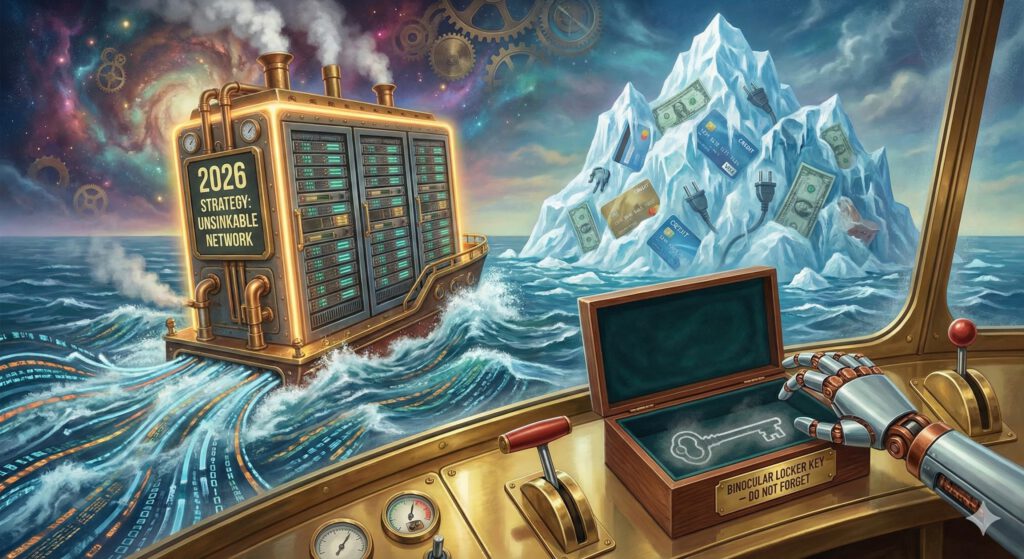
We have spent the last decade obsessed with connectivity. We bought the bigger pipes (WiFi 6E, WiFi 7). We bought the smarter overlays (SD-WAN, SASE). We successfully connected everything to everything else.
And now, we are paying the price.
The era of “Just Connect It” is over. We are entering the Era of Intelligent Resilience. And frankly, most of you aren’t ready for the bill—literally.
1. The Physics of “More” (Or: Why Your Power Bill is the New Threat Vector)
Let’s talk about WiFi 7. The marketing sheets are beautiful, aren’t they? 320 MHz channels, 4K QAM, throughput that makes a CAT5 cable blush. It’s the Lamborghini of wireless.
But nobody tells you about the gas mileage.
The second-order effect of upgrading to WiFi 7 isn’t faster email; it’s a blown circuit breaker. To drive that kind of density and throughput, the power requirements for your Access Points (APs) aren’t creeping up; they are skyrocketing.
We are seeing projections that AI workloads and the infrastructure to support them (like high-density switching and next-gen wireless) could double data center power consumption by 2030 according to Gartner
The Physics Reality Check
You can’t cheat physics. Higher frequency processing and denser radio modulation require more energy.
We haven’t had to worry about this for a while with so much gear becoming more efficient. There has always been excess capacity as big gear gets replaced with smaller more efficient gear. However, on your next wifi upgrade its going to be different…
You budget for the new APs. You budget for the multi-gig switches. Then you *forgot* to budget for the HVAC upgrade needed to cool the closets that were suddenly generating 40% more heat.
That is Resilience failing.
Intelligent Resilience means asking the unsexy questions:
- Do we have the POE++ budget on the switch?
- Can the UPS handle the load if the grid browns out?
- Does the “Smart Building” sensor array actually need 6GHz connectivity, or is that just vendor bloat?
We are moving from a world where we deploy for maximum theoretical speed to one where we verify for sustainable operational reality.
2. The Cultural Firewall: NetOps vs. SecOps
The industry loves the acronym SASE (Secure Access Service Edge). It sounds sleek. It sounds unified. It promises that your network team and your security team will finally hold hands and sing Kumbaya while managing a single policy engine.
In practice, it’s more like Gen Z and Boomers trying to plan a Christmas party.
The tools have converged. The culture has not.
In my experience, “Convergence” is usually code for “Make the Network Guy do the Security Guy’s job, but don’t pay him more.”
The Skills Gap Friction
You see this friction in the tickets. NetOps closes a ticket: “Traffic is flowing. Job done.”
SecOps re-opens it 10 minutes later: “Traffic is unencrypted. Job failed.”
With the rise of “self-driving” networks and AI ops, this cultural friction is becoming the primary bottleneck. A recent report from IDC highlighted that despite the tech being ready, cultural resistance is the big blockers to automated network operations.
Intelligent Resilience isn’t about buying a tool that claims to do both. It’s about orchestration. It’s about building a process where a firewall change doesn’t require an act of congress, but also doesn’t leave the back door open for a script kiddie in their parents basement.
If you don’t fix the culture, the “Single Pane of Glass” just becomes a single point of blame.
3. The Great Repatriation: The Cloud Hangover
Remember 2020? “Cloud First!” “All in on AWS!” “Own nothing!”
Well, it’s 2026, and the credit card bill has arrived. And it is ugly.
We are seeing a massive trend of Cloud Repatriation.
This isn’t a retreat; it’s a correction. Companies are realizing that renting a computer from Jeff Bezos is great for bursting, but it’s a terrible financial strategy for steady-state storage of petabytes of archival data.
The “Bill Shock” Phenomenon
Data points are screaming this. Up to 83% of CIOs are planning to move at least some workloads back on-prem or to private clouds this year. Only 8-9% plan to fully repatriate, but this trend shows the pendulum is swinging towards longer term stability with the split going where costs make sense. Turns out 100% of anything is often ideal.
Why? Intelligent Resilience requires financial resilience.
If your cloud bill fluctuates by 40% month-over-month because of “Egress Fees” you didn’t understand, you don’t have a resilient business model. You have a gambling addiction.
We are seeing the return of the “Physical Constraint.” You have to order the servers. You have to rack them. You have to cool them. (See point #1). But you own the latency, and you own the cost.
For the strategist, this means your network needs to be truly hybrid. Not “Hybrid” like a marketing slide, but “Hybrid” like a mechanic who works on both Teslas and 69 Mustangs. You need to route traffic based on cost and sovereignty, not just bandwidth.
4. The AI Hallucination: Trust but Verify
Finally, we have to address the 800-pound gorilla that hallucinates: AI.

Every vendor in my inbox is selling “AI-Driven Operations.” They promise a network that heals itself. A network that predicts the outage before it happens.
And sure, when it works, it’s magic.
But when it fails? It’s a catastrophe.
Intelligent Resilience means tempering the integration of AI with cold, hard verification.
The “Self-Driving” Fallacy
It’s like self-driving cars. I love the idea of my car driving me to work. I do not love the idea of my car deciding that a stop sign is a suggestion.
In networking, an AI might decide to “optimize” a route by sending all your VoIP traffic through a link that saves 2 cents per gigabyte, completely ignoring that the latency on that link makes everyone sound like a robot underwater.
The AI sees “Efficiency.” The User hears “Broken.”
You cannot automate what you do not understand. If you don’t know how the packet gets from A to B manually, you have no business letting an algorithm do it automatically. To expand further on that, if you don’t know what the application does for the business, you can’t know how to optimize it.
Rule of Thumb: AI is your co-pilot, not your captain. Keep your hands near the wheel. (Side note: if you’ve used O-365 co-pilot, you’ll know just how much its not captain material either.)
Conclusion: The “Diet” of Resilience
The Titanic didn’t sink because of bad engineering; it sank because of a process failure in a single pocket.
This teaches us that Resilience is not a product. You cannot buy a box that makes you resilient.
- You can buy a generator, but you have to test it.
- You can buy a firewall, but you have to audit the rules.
- You can buy AI, but you have to verify the output.
Resilience is a diet. It’s the daily, boring work of checking the logs, cleaning the configs, and ensuring the keys to the binocular locker are actually handed over before the ship leaves port. Its also the enablement of communication and trust for your teams to speak up when something is missing or wrong, before you leave port, not just in the courtroom post accident.
The era of “Intelligent Resilience” is here. It’s messy. It’s hybrid. It’s constrained by physics and budgets.
But it’s real. And frankly, I prefer the mess utilizing real engineering over the marketing slide deck utilizing magic.
Now, if you’ll excuse me, I can’t remember if I left the key in my other coat.