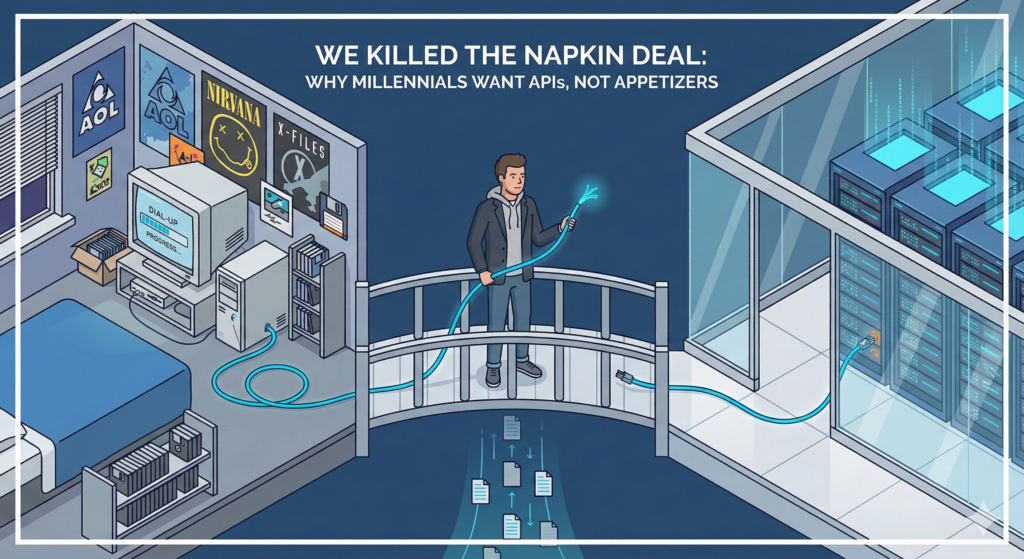
Being a Millennial in the technology sector is a unique form of existence. It’s like being the only person in the room who knows how to drive a stick shift *and* program a Tesla. We are the “Bridge Generation.” We remember the sound of a dial-up modem screaming its handshake—the specific screech and static that meant the world was opening up—but we also built the cloud infrastructure that made silence the new standard.
I remember my first “sales dinner” early in my engineering career. There was expensive drinks, small talk about golf (a sport I didn’t play), and a lot of posturing. I kept thinking about that line ‘This meeting could have been an email’.
That was the moment the “Napkin Deal” died.
For decades, business was done on relationships. It was done on the handshake, the dinner, the long game. But for my generation, graduating directly into the teeth of a Recession and entering the workforce just as the iPhone was born, business isn’t about relationships. It’s about throughput.
The Rosetta Stone of IT
In my current role in Product at a telecom, I often feel like I am the designated translator for an entire industry. I spend half my day translating “Boomer Executive” dialect—which speaks in terms of Revenue, Relationship, Risk, and “The Rolodex”—into “Gen Z Developer” dialect—which speaks in Latency, API calls, Tech Debt, and Git commits. Somehow we have to bridge the two sides into a cohesive approach that satisfies the old guard and makes sense to the new interns.
We lived through the transition. We saw the Twin Towers fall on live TV in our classrooms. We watched the housing market collapse just as we got our degrees. We learned the hard way that institutions—banks, housing markets, corporate career ladders—aren’t as stable as our parents promised.
Because of this, we don’t worship the process. We don’t worship the institution. We celebrate Efficiency.
If a tool works, we use it. If it doesn’t, we discard it. We have zero loyalty to a brand that wastes our time. This informs everything about how we buy, use, and deploy technology.
Optimization is our Love Language
If Gen Z is the “Skeptical Power User,” Millennials are the “Pragmatic Architects.” We treat AI and automation like a cheat code for a game we are tired of playing.
I don’t use generative AI because it’s cool. I don’t use it to make funny pictures of cats. I use it because I have four kids, a mortgage, a lawn that needs mowing, and a backlog of products to manage in between meetings. I also have a wife I actually want to spend time with.
If an AI can write the first draft of this email, I get to leave the office 15 minutes earlier. That’s the ROI. It’s not about “Innovation”; it’s about “Reclaiming Time.” You better bet this article went through AI to optimize my effort as well!
We are the generation that turned “Life Hacks” into an industry. We automated our bills. We “hacked” our travel points to get free flights. We optimized our diets. And now, we are hacking our workflows. A Millennial looks at a repetitive task—scheduling emails, sorting logs, updating Jira tickets—and sees a failure of imagination. We automate it so we can stop thinking about it.
They say engineers will spend an inordinate amount of time and effort to save a tiny bit of energy. As a millennial engineer, I feel seen.
The Friction Point: Stop Selling Experience, Start Selling Time
Here is where vendors lose us. They try to sell us an “Experience” when we are trying to buy “Time.”
I see this constantly in B2B marketing. A vendor pitches me a “White Glove Onboarding Experience.” They promise a dedicated Customer Success Manager who will “walk me through the journey.”
To a Millennial, that sounds like a threat. A slow, time-sink threat.
I don’t want to talk to your onboarding specialist. I don’t want to schedule a 30-minute Zoom call to learn how to change my password. I want a clean documentation page. I want a sandbox environment I can spin up at 11 PM on a Tuesday. I want a straight-forward pricing model that doesn’t require a “Custom Quote.”
If I have to talk to a human to find out how much your software costs, I assume you are hiding something. I assume it’s too expensive, or the price is arbitrary. I only want to chat when I need more scale and better pricing than you publish, then its worth my time.
We grew up with MySpace, where we had to learn basic HTML just to make our profile background glitter (and ruin the page load time for everyone else). I remember the first time I discovered the HTML blink tag and created atrocities on my personal website in the last millennium. We aren’t afraid of the code. We aren’t afraid of the configuration file. We are afraid of the meeting that could have been an email.
The Shift to Self-Service
This is why the “Portal” is becoming the most important product feature. For Millennials, the quality of your self-service portal is the quality of your product.
If I can upgrade my bandwidth, add a seat to my license, or debug a connection error without opening a support ticket, I love your product. If I have to call a 1-800 number and listen to hold music just to reset a VLAN, I hate your product. It doesn’t matter how fast the network is; the administrative latency is too high.
We are driving the shift to “Product-Led Growth” not because it’s a trendy business school concept, but because it matches our psychological need for control. We want to drive the car. We don’t want a chauffeur.
The Takeaway: Give Us the Keys
If you are selling to a Millennial—and chances are you are, because we are the ones becoming the VPs and Directors right now—you need to respect the one resource we can’t generate more of: Time.
Don’t force the meeting. Offer an async option.
Don’t hide the manual. Make your knowledge base public.
Don’t gate the pricing. Be transparent.
We are the exhausted middle managers holding the bridge together between the analog past and the automated future. We are tired. We are busy. We want tools that work, APIs that connect, and a “Cancel Subscription” button that functions instantly.
We built the digital world you live in. We wrote the code, we laid the fiber, we debugged the servers. Now, we just want to log off so we can go enjoy it.